Looking for a reliable stand up weight scale? This guide compares top options that balance accuracy, stability, and ease of use. It highlights scales suited for home fitness, elder care, clinics, and bariatric needs. Each pick is described with who it’s best for, plus practical pros and limitations. Use the quick reference table to compare core specs at a glance.
| Product | Capacity | Best For | Key Benefit |
|---|---|---|---|
| Jobar Digital Scale | Up to 550 lbs | Vision-impaired users, households needing large displays | Extendable display for easy reading |
| Health o meter Mechanical Beam | 390 lb | Clinics and professional settings | Mechanical precision with simple readouts |
| TooCust Digital With Handles | 485 lb | Elderly or mobility-challenged users | Handles and height measurement for stability |
| Vivacomfort Digital | 660 lb | High capacity with digital readout and BMI | |
| Health o Meter Eye-Level | 500 lb | Eye-level display and BMI features |
Jobar Digital Scale With Extendable Display
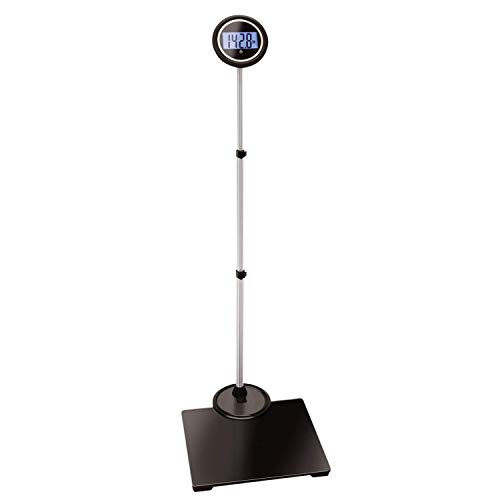
The Jobar scale features a round digital weight display that extends from 23″ to 46″ on a telescoping pole, making results easy to read without bending. It uses a wide 13″ x 15″ tempered glass platform for stability and comfort. This model is best for users who want a tall, readable readout and a sturdy surface for secure footing.
Best for vision-impaired users or households needing a clearly visible readout. The extendable display reduces neck strain and enhances viewing comfort. A potential limitation is its reliance on a digital mechanism, which may require more battery management than a purely mechanical unit.
Health o meter Professional Mechanical Beam Scale
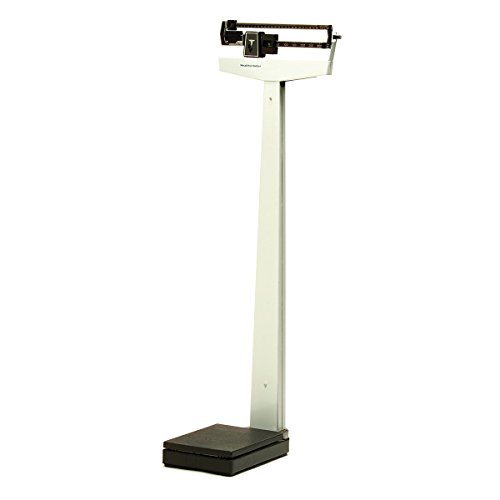
This mechanical beam scale offers high precision with a capacity of 390 lb and 1/4 lb/100 g graduations. Its powder-coated construction ensures durability in high-use environments such as clinics, while a non-slip platform mat adds safety for steady readings. It is ideal for professional settings that prefer mechanical reliability over digital displays.
Best for clinics or offices prioritizing mechanical accuracy and rugged durability. Choose this if you want simple operation without electronics. A limitation is that it lacks digital readouts and BMI calculations, which some users may rely on.
TooCust Digital Scale With Handles

This medical-grade digital scale includes two white C-shaped anti-tipping handrails, a wide 19″ height-adjustable telescopic bar, and a 485 lb capacity. It is designed for elderly or mobility-impaired users who require support during measurement. The height measurement ranges from 28″ to 75″ for full-body tracking.
Best for patients needing extra stability with height tracking. It’s a strong choice for doctor offices or home health use. A potential limitation is the more complex installation for the rails, which may require assistance during setup.
Vivacomfort Digital Medical Scale

The Vivacomfort digital scale supports up to 660 lb and displays weight on a large screen. It additionally offers BMI calculation, unit conversion (lb/kg), and optional AC power or rechargeable battery operation. A safety mat and a generous platform provide stability for patients during weighing.
Best for high-volume medical offices or clinics needing a robust, feature-rich digital scale. Choose this if you require BMI readouts and flexible power options. A limitation is that the device’s size and weight may be less suitable for very tight spaces.
Health o Meter Eye-Level Digital Scale

This eye-level digital scale reads up to 500 lb with 0.2 lb increments and features a 1-inch LCD for easy viewing at eye level. It includes BMI functionality and unit options (kg/lb), making it suitable for clinics that prioritize simple, clear readouts. It’s a solid choice for standing weigh-ins in patient rooms.
Best for clinical environments that value straightforward, readable data. Avoid this if a larger capacity model or more advanced features like wireless syncing are needed, as those are not specified here.
Buying Guide: How to Choose a Stand Up Weight Scale
What capacity do you actually need?
Residential use often requires scales that cover at least 300–550 lb. Clinics and bariatric contexts may need higher capacity (up to 660 lb) and sturdier platforms. Always match capacity to the heaviest user who will regularly use the scale.
What display type suits your space?
Extendable or eye-level displays improve readability for users with vision challenges or neck strain. Digital readouts provide BMI or unit conversions, while mechanical beam scales emphasize durability and simplicity in busy settings.
Is stability or safety a priority?
Look for non-slip platforms, wide foot spaces, anti-tipping rails, and sturdy frames. For elderly users or those with mobility issues, handrails and wide platforms improve confidence during weighing.
Do you need extra features?
BMI calculation, unit switching (lb/kg), battery life or AC power, and data hold functions can be decisive. For clinical use, some scales offer easy charting or integration-friendly data outputs; for home use, a simple display may suffice.
What about installation and space?
Mechanical scales are typically easier to set up and require less maintenance. Digital scales may need more storage space for the base and can be bulkier. Ensure there is a flat, stable surface with enough clearance around the scale.
Durability and environment
Powder-coated metal frames and tempered glass platforms offer longevity in high-use settings. Consider scales designed for medical or heavy-duty use if the environment involves frequent transfers or rough handling.
FAQ
- What is the typical weight capacity I should look for?
Aim for 390–660 lb depending on user needs and environment. High-capacity models reduce the risk of overloading. - Is a digital scale better than a mechanical beam scale?
Digital scales offer BMI, unit conversions, and easier reading, while mechanical scales excel in durability and simple operation without batteries. - Are height measurement features common?
Many scales pair weight with height measurements or telescoping bars, which helps track BMI trends over time. - Do these scales require special installation?
Most scales require a flat surface and secure placement. Some with rails or anti-slip mats may involve a bit more assembly. - Can I use these scales in a clinical setting?
Yes, several options are designed for clinics, with sturdy frames, durable materials, and clearer displays for patient safety. - Should I prioritize BMI functionality?
If you monitor health trajectory or clinical assessments, a scale with BMI and unit conversions can be beneficial.